Like you're a high-powered machine, getting more done in less time. For decades, multitasking was hailed as the ultimate badge of honor in the fast-paced modern world. But what if I told you that this perceived superpower is actually a sneaky villain, silently sabotaging your efficiency and even your brain?
The truth is, the supposed brilliance of multitasking vs single-tasking has been widely debated, and the science is increasingly pointing to a clear winner in the efficiency race. While it might feel like you're accomplishing more, the reality is often a cascade of errors, missed details, and fractured attention. The myth of the super-multitasker is finally being debunked, making way for a more focused, intentional approach to work and life.
Forget the pervasive multitasking productivity myths that have held us captive for too long. It’s time to explore the profound single-tasking benefits and understand why cultivating focus vs multitasking isn't just a trend, but a fundamental shift towards true efficiency and mental well-being.
In this deep dive, we'll peel back the layers of this fascinating topic. We'll explore the science behind multitasking and brain performance, uncover the hidden costs of cognitive overload from multitasking, and arm you with actionable strategies on how to single-task effectively.
1. Is multitasking good or bad for productivity?


For decades, the ability to multitask was seen as a desirable skill, a sign of efficiency and adaptability in a demanding world. However, scientific research and real-world observations increasingly reveal a stark truth: is multitasking good or bad for productivity? The overwhelming evidence points to it being bad for productivity.
Here's why:
The Illusion of Multitasking: First, it's crucial to understand that true multitasking – doing two or more cognitively demanding tasks simultaneously – is a myth for most humans. What we typically call multitasking is actually rapid task-switching. Your brain isn't processing information in parallel; it's quickly shifting its attention back and forth between different tasks. Each time it switches, there's a cognitive cost.
The Costs of Task-Switching:
-
Reduced Efficiency and Increased Time:
-
Studies consistently show that task-switching makes you slower. Psychologists refer to this as "switch cost." Each time you switch tasks, your brain needs to reorient itself, recall where you left off, and load the new context. This adds seconds, even minutes, to each task, accumulating into significant time waste over a day. You might feel busy, but you're less productive overall. This is a core reason why multitasking doesn't work for true efficiency.
-
-
Increased Errors:
-
When your attention is divided, your ability to perform tasks accurately decreases. Details are missed, mistakes are more frequent, and the quality of your output suffers. This is a direct consequence of multitasking and brain performance being compromised.
-
-
Cognitive Overload and Mental Fatigue:
-
Constantly shifting focus puts a heavy strain on your prefrontal cortex, the part of your brain responsible for executive functions like planning, decision-making, and problem-solving. This leads to cognitive overload from multitasking, making you feel mentally drained and exhausted, even after a seemingly "productive" day.
-
-
Reduced Memory and Learning:
-
When you're multitasking, information isn't encoded into your memory as effectively. You might remember bits and pieces, but your ability to form deep, lasting memories or truly learn new concepts is impaired.
-
-
Diminished Focus and Attention Span:
-
Chronic multitasking can actually rewire your brain, making it harder to sustain attention on a single task, even when you want to. Your attention span and multitasking become intertwined in a negative feedback loop. You become more easily distracted, constantly craving novelty and new inputs.
-
-
Higher Stress Levels:
-
The feeling of constantly being pulled in multiple directions, the pressure to keep up, and the awareness of dropped balls contribute to increased stress and anxiety. (We'll delve deeper into is multitasking linked to anxiety? later).
-
Exceptions (The Nuance):
It's important to note that not all simultaneous activities are detrimental. True multitasking (doing two things at once) is only possible when one of the tasks is automatic and requires very little cognitive effort, such as:
-
Listening to music while exercising.
-
Walking and talking.
-
Eating while reading a simple article.
However, when it comes to cognitively demanding work – writing, problem-solving, complex decision-making, coding – multitasking is demonstrably detrimental.
In conclusion, for meaningful, high-quality work, multitasking is bad for productivity. The perceived benefits are largely an illusion, while the hidden costs in terms of efficiency, quality, and mental well-being are substantial. Embracing single-tasking is the path to real gains.
People Also Ask: Is multitasking good or bad for productivity? Is multitasking good or bad for productivity? The overwhelming scientific evidence indicates it is bad for productivity. What we perceive as multitasking is actually rapid task-switching, which incurs a "switch cost," making you slower, increasing errors, and leading to significant time waste, fundamentally illustrating why multitasking doesn't work for true efficiency. This process results in cognitive overload from multitasking, severe mental fatigue, reduced memory and learning capabilities, and a diminished attention span and multitasking creating a negative feedback loop. Ultimately, while seemingly productive, the pros and cons of multitasking heavily favor the "cons" for cognitively demanding tasks, confirming that multitasking productivity myths mislead us about its true impact on multitasking and brain performance.
2. What are the downsides of multitasking?


Beyond the general impact on productivity, a closer look reveals numerous specific downsides of multitasking that affect not just our output, but our mental and physical well-being. Understanding these pitfalls is crucial for anyone considering the multitasking vs single-tasking debate seriously.
Here are the primary disadvantages:
-
Decreased Efficiency and Quality of Work:
-
As discussed, the "switch cost" means it takes longer to complete individual tasks when you're constantly jumping between them. You spend valuable mental energy re-orienting yourself. This directly impacts the perceived multitasking productivity myths.
-
The quality of your work suffers because your attention is fractured. You're more prone to errors, missing details, and producing less thorough output. This is a significant aspect of why multitasking doesn't work.
-
-
Increased Stress and Mental Fatigue:
-
The brain is not designed for constant, rapid task-switching. Trying to force it into this mode creates a sense of frantic urgency and cognitive strain. This leads to cognitive overload from multitasking, resulting in mental exhaustion, brain fog, and decision fatigue, even at the end of a seemingly "busy" day.
-
The feeling of always being behind or stretched too thin significantly raises stress levels.
-
-
Impaired Learning and Memory:
-
When you're multitasking, your brain struggles to properly encode new information. You're less likely to retain what you've read or heard. This is because multitasking and brain performance are negatively intertwined; the brain prioritizes the act of switching over the act of deep processing.
-
Studies have shown that students who multitask while studying retain less information and perform worse on tests.
-
-
Reduced Attention Span and Focus:
-
Chronic multitasking can literally rewire your brain, making it difficult to concentrate on a single task for extended periods. You become more susceptible to distractions and develop a need for constant stimulation, eroding your natural attention span and multitasking capability. This makes focus vs multitasking a critical consideration.
-
-
Emotional and Psychological Impact:
-
Increased Anxiety: The constant pressure to juggle multiple demands can lead to heightened anxiety and a feeling of being overwhelmed. (We'll explore is multitasking linked to anxiety? in more detail).
-
Lower Job Satisfaction: Despite feeling busy, the lack of deep work and tangible progress can lead to lower satisfaction and a sense of unfulfillment.
-
Burnout: The continuous cognitive drain and heightened stress contribute significantly to professional burnout.
-
-
Longer Completion Times for Projects:
-
While you might be working on multiple projects simultaneously, the time it takes to complete any single project often extends. You're spreading your effort thinly across many tasks rather than concentrating it to finish one.
-
-
Poor Decision-Making:
-
When your cognitive resources are spread thin, your ability to think critically, analyze complex information, and make sound decisions is impaired. You're more likely to make snap judgments or overlook critical factors.
-
-
Damaged Relationships (in social contexts):
-
In conversations, attempting to multitask (e.g., checking your phone while someone is talking) signals disrespect and a lack of engagement, damaging personal and professional relationships.
-
These pros and cons of multitasking clearly illustrate that the drawbacks far outweigh any perceived benefits for tasks requiring genuine mental effort. Shifting towards single-tasking for mental clarity and improved output is a strategic move for sustainable productivity.
People Also Ask: What are the downsides of multitasking? The downsides of multitasking are significant. Firstly, it leads to decreased efficiency and quality of work due to "switch costs" and increased errors, directly debunking multitasking productivity myths and explaining why multitasking doesn't work for genuine output. Secondly, it causes increased stress and mental fatigue, contributing to cognitive overload from multitasking and burnout. Thirdly, it impairs learning and memory because multitasking and brain performance are negatively affected, hindering information encoding. Fourthly, it reduces attention span and focus, creating a detrimental link between attention span and multitasking where the brain becomes rewired for distraction. Furthermore, there's a strong link to increased anxiety (is multitasking linked to anxiety?) and lower job satisfaction. Overall, the pros and cons of multitasking heavily lean towards the cons, advocating for focus vs multitasking as the path to single-tasking for mental clarity and effective time management and multitasking.
3. Does single-tasking improve focus?


After exploring the detrimental effects of multitasking, the natural question arises: does single-tasking improve focus? The answer, unequivocally, is yes. Single-tasking is not just about avoiding distraction; it's about actively cultivating and strengthening your ability to concentrate, leading to deeper engagement and higher quality output. This is the cornerstone of focus vs multitasking.
Here's how single-tasking profoundly impacts and improves your focus:
-
Eliminates Context Switching Costs:
-
When you commit to one task, your brain doesn't have to constantly reorient itself. There's no "switch cost" to pay. This means all your cognitive resources can be directed towards the task at hand, allowing you to get into a state of flow faster and sustain it longer.
-
This direct allocation of mental energy is the primary reason for single-tasking benefits in focus.
-
-
Reduces Cognitive Overload:
-
By focusing on one thing at a time, you prevent your brain from being overwhelmed by multiple demands. This reduces mental fatigue and allows for sustained concentration without the constant sensation of being pulled in different directions. It's the antidote to cognitive overload from multitasking.
-
-
Strengthens Neural Pathways for Concentration:
-
Just like a muscle, your ability to focus strengthens with practice. Regularly engaging in single-tasking trains your brain to sustain attention, making it easier to concentrate over time. You're actively building and reinforcing the neural pathways associated with deep concentration, effectively changing how multitasking and brain performance operates. This relates to the question: can you train your brain to single-task? (and the answer is yes!).
-
-
Enables Deeper Processing and Learning:
-
When your focus is undivided, your brain can process information more thoroughly and efficiently. You're better able to understand complex concepts, make connections, and retain information, leading to genuine learning and improved memory. This contrasts sharply with the superficial processing that occurs during multitasking.
-
-
Cultivates Mindfulness and Presence:
-
Single-tasking naturally encourages a state of mindfulness. By dedicating your full attention to one activity, you become more present in the moment, more aware of the nuances of the task, and less prone to mind-wandering. This is why multitasking vs mindfulness is a significant comparison – mindfulness inherently aligns with single-tasking.
-
-
Enhances Problem-Solving and Creativity:
-
Complex problems often require sustained, uninterrupted thought. When you single-task, you create the mental space necessary for critical thinking, innovative problem-solving, and creative breakthroughs. Distraction, on the other hand, fragments these processes. This is the essence of deep work vs multitasking.
-
-
Reduces the Urge to Seek Novelty:
-
When you consistently provide your brain with the challenge of sustained focus, it gradually reduces its craving for constant new inputs. You become less susceptible to the pull of notifications and external distractions, further strengthening your attention span and multitasking resilience.
-
In essence, single-tasking is a deliberate act of attention management. By choosing to direct your full cognitive power to one activity at a time, you not only improve your immediate output but also systematically enhance your long-term capacity for focus, leading to a profound transformation in your overall productivity.
People Also Ask: Does single-tasking improve focus? Yes, single-tasking absolutely improves focus. By eliminating context switching costs, it allows all your cognitive resources to be directed towards one activity, directly enhancing focus vs multitasking and leading to profound single-tasking benefits. It effectively reduces cognitive overload from multitasking, allowing your brain to process information more thoroughly. Consistent single-tasking also strengthens neural pathways for concentration, proving that you can train your brain to single-task. This approach enables deeper processing and learning, contrasts sharply with the superficiality of multitasking and brain performance, and naturally cultivates mindfulness, highlighting the significant difference between multitasking vs mindfulness. Ultimately, it supports deep work vs multitasking by fostering sustained concentration for complex problem-solving and creative tasks, improving your attention span and multitasking capabilities and overall productivity.
4. Why is multitasking less effective?


The persistent belief that multitasking makes us more productive stems from a fundamental misunderstanding of how our brains actually work. Why is multitasking less effective? The answer lies deep within our cognitive architecture, revealing that what appears to be efficiency is, in reality, a significant drain on our mental resources and ultimately reduces both speed and quality of work.
Here's a detailed breakdown of why multitasking falls short:
-
The Brain Doesn't Multitask (It Task-Switches):
-
As mentioned earlier, your brain isn't performing multiple complex tasks simultaneously. Instead, it's rapidly shifting its attention from one task to another. This is called task-switching, and it's the core reason why multitasking doesn't work.
-
Imagine two different programs running on an old computer – you're not running them concurrently, you're constantly minimizing and maximizing, which takes time and processing power.
-
-
"Switch Cost" is Real and Significant:
-
Every time your brain switches from one task to another, there's a cognitive cost. This "switch cost" involves:
-
Re-orientation: Your brain has to disengage from the previous task's rules and goals.
-
Re-activation: It then has to activate the rules and goals for the new task.
-
Information Reload: It needs to recall where you left off on the new task.
-
-
This process, though seemingly quick (milliseconds), adds up. Research by psychologists has shown that these switch costs can reduce productivity by as much as 40%. This is the stark reality behind multitasking productivity myths.
-
-
Fragmented Attention and Reduced Processing Depth:
-
When your attention is constantly divided, you can't fully immerse yourself in any single task. This leads to superficial processing of information. You might skim, but you don't truly comprehend or analyze deeply.
-
This directly impairs deep work vs multitasking, as deep work requires sustained, uninterrupted focus.
-
-
Increased Error Rate:
-
Divided attention means more mistakes. When you're not fully engaged, it's easier to overlook details, misinterpret information, or make careless errors. The quality of your output invariably suffers. This is a crucial downsides of multitasking.
-
-
Cognitive Overload and Mental Exhaustion:
-
The constant effort of task-switching puts immense strain on your prefrontal cortex, which is responsible for critical thinking, planning, and decision-making. This leads to cognitive overload from multitasking, draining your mental energy much faster than focused work. You might feel "busy," but you're just exhausting your brain.
-
-
Diminished Memory Formation and Learning:
-
For new information to be properly encoded into long-term memory, it requires focused attention. When you're multitasking, your brain doesn't have the capacity to form strong, lasting memories of the tasks or information you're interacting with. This negative impact on multitasking and brain performance makes learning less effective.
-
-
Prolonged Task Completion Times:
-
While it feels like you're getting things done faster because you're touching multiple tasks, the actual time it takes to complete any single task is longer due to the constant interruptions and re-starts. Your overall efficiency drops.
-
-
Increased Stress and Anxiety:
-
The feeling of constantly being pulled in different directions, the pressure to keep up with multiple inputs, and the awareness of performing poorly contribute to elevated stress hormones. This is a direct link between multitasking and anxiety that is frequently overlooked.
-
In essence, multitasking is less effective because it forces your brain to operate inefficiently, expending valuable cognitive resources on switching rather than on actual work. This leads to slower progress, more errors, and greater mental fatigue, making a strong case for prioritizing single-tasking as the true path to efficiency.
People Also Ask: Why is multitasking less effective? Multitasking is less effective because the human brain doesn't truly multitask; it rapidly task-switches, incurring a significant "switch cost" that can reduce productivity by up to 40%, directly debunking multitasking productivity myths. This constant shifting leads to fragmented attention, superficial processing, and an increased error rate, making it a key downsides of multitasking. The brain experiences cognitive overload from multitasking, leading to mental exhaustion and diminished decision-making. Furthermore, it impairs memory formation and learning due to the negative impact on multitasking and brain performance, and ultimately prolongs overall task completion times. The continuous cognitive strain also contributes to increased stress and anxiety (is multitasking linked to anxiety?), highlighting why multitasking doesn't work for achieving high-quality, efficient output and emphasizing the benefits of deep work vs multitasking.
5. Can you train your brain to single-task?


The good news, after understanding the pitfalls of multitasking, is that can you train your brain to single-task? is a resounding yes! Our brains are remarkably plastic, meaning they can adapt and change based on our habits and practices. Just as chronic multitasking can diminish your attention span and multitasking capacity, intentional single-tasking can strengthen your ability to focus and engage deeply.
Here’s how you can train your brain to embrace single-tasking and cultivate stronger focus:
-
Start Small and Build Momentum:
-
Don't try to go from constant multitasking to perfect single-tasking overnight. Choose one specific task or a short period (e.g., 25 minutes using the Pomodoro Technique) where you commit to absolute single-tasking.
-
Gradually increase the duration and number of single-tasking blocks as your "focus muscle" gets stronger.
-
-
Eliminate Distractions Ruthlessly:
-
This is the cornerstone of how to single-task effectively.
-
Digital Notifications: Turn off all non-essential notifications on your phone, computer, and email. Put your phone in another room or on airplane mode during focused work.
-
Close Unnecessary Tabs: Only keep the tabs open that are directly relevant to the task at hand. Use browser extensions that block distracting websites if necessary.
-
Inform Others: Let colleagues or family know you're entering a "focus block" and request no interruptions unless it's an emergency.
-
-
The less tempting it is to switch, the easier it becomes to stay focused.
-
-
Use Time Blocking (The "Meeting with Yourself"):
-
Schedule specific, uninterrupted blocks of time in your calendar for individual, high-priority tasks. This creates a commitment and tells your brain, "This is what we're doing now, and nothing else." (This is a core productivity technique 2025 strategy for building focus).
-
Treat these blocks as non-negotiable appointments.
-
-
Practice Mindfulness and Awareness:
-
Multitasking vs mindfulness is a direct contrast. Mindfulness practices (like meditation) train your brain to stay in the present moment and observe thoughts without getting carried away by them. This directly translates to improved focus during work.
-
During tasks, periodically check in with yourself: "Am I truly focused on this? Or is my mind wandering?" Gently bring your attention back.
-
-
Break Down Large Tasks:
-
Overwhelming tasks are often a trigger for procrastination and subsequent multitasking (as you jump to easier things). Break large projects into smaller, manageable sub-tasks. Then, single-task on one sub-task at a time. This makes the commitment to single-tasking less daunting.
-
-
Schedule "Distraction Blocks":
-
Instead of constantly checking email or social media, schedule specific times for these activities. Knowing you'll get to them later can reduce the urge to switch. For example, "Email Block: 11:00 AM - 11:30 AM."
-
-
Take Intentional Breaks:
-
Short, deliberate breaks (5-10 minutes) every hour or so can refresh your brain and actually improve your ability to focus when you return to the task. Use these breaks for movement, stretching, or a quick mental reset, not for jumping into another cognitively demanding activity.
-
-
Reflect and Adjust:
-
At the end of each day, reflect on your single-tasking efforts. What went well? Where did you get derailed? Use these insights to refine your approach for the next day. This iterative process helps solidify the habit.
-
By consistently applying these strategies, you can gradually rewire your brain away from the detrimental habit of constant task-switching towards the powerful, efficient mode of single-tasking, leading to increased productivity and greater mental clarity.
People Also Ask: Can you train your brain to single-task? Yes, you absolutely can train your brain to single-task. This involves actively counteracting the negative impact of multitasking and brain performance by implementing deliberate strategies on how to single-task effectively. Start small, commit to eliminating distractions ruthlessly (digital notifications, unnecessary tabs), and use time blocking to create dedicated periods for focused work, treating them as non-negotiable appointments – a key productivity technique 2025. Practice mindfulness to strengthen your present-moment awareness, as multitasking vs mindfulness reveals contrasting approaches to attention. Break down large tasks, schedule "distraction blocks," and take intentional breaks. Through consistent practice, you can build your attention span and multitasking resilience, making it easier to maintain focus vs multitasking and experience the profound single-tasking benefits for better productivity and mental clarity.
6. What is an example of single-tasking?


Sometimes, understanding a concept is easiest through a clear illustration. So, what is an example of single-tasking? It's not just about doing one thing; it's about doing one thing with undivided attention, free from internal and external distractions.
Here are a few concrete examples of single-tasking in action, contrasting them with their multitasking counterparts:
Example 1: Responding to Email
-
Multitasking: You're working on a report, an email notification pops up, you click it, respond quickly, then jump back to the report. Another email comes in, you switch again. You do this all day.
-
Single-Tasking: You schedule a specific time block in your calendar (e.g., "Email Hour" from 10:00 AM to 11:00 AM). During that hour, your email application is the only thing open. You process emails: reply, archive, delete, or add tasks to a to-do list if they require more than a quick response. For the rest of the day, your email is closed, and notifications are off.
-
Benefit: During your "Email Hour," you're highly efficient, processing messages quickly. For the rest of the day, your brain is free to focus completely on other tasks without interruption. This is a core single-tasking benefit.
-
Example 2: Writing a Report/Document
-
Multitasking: You're writing a report, but you're also toggling between research articles, checking Slack for messages, perhaps glancing at social media, and thinking about what you'll make for dinner.
-
Single-Tasking: You close all irrelevant tabs and applications. You silence your phone and put it out of reach. You open only the document and perhaps one or two necessary research windows. You set a timer for 60-90 minutes and commit to only working on the report. If a thought about something else pops up, you quickly jot it down on a scratchpad for later, and immediately return to the report.
-
Benefit: You get into a state of deep work vs multitasking, allowing for coherent thought, better flow, and a higher quality, more thoroughly written report in less actual time. This is a perfect illustration of focus vs multitasking.
-
Example 3: Having a Conversation/Meeting
-
Multitasking: You're on a video call or in a meeting, but you're simultaneously typing notes for another project, checking email, or Browse the internet.
-
Single-Tasking: You close all other applications. You make eye contact (virtually or in person). You actively listen, ask clarifying questions, and fully engage with the discussion. If you need to take notes, you do so diligently, but your primary focus remains on the conversation.
-
Benefit: You fully comprehend the discussion, contribute more effectively, build stronger rapport, and are less likely to miss crucial information or action items. This highlights the real-world pros and cons of multitasking beyond just individual output.
-
Example 4: Learning a New Skill/Studying
-
Multitasking: You're watching an online tutorial while also responding to texts, Browse social media, or even intermittently watching a TV show.
-
Single-Tasking: You dedicate a specific block of time solely to the learning material. You put away your phone, close all distracting tabs, and actively engage with the content – taking notes, pausing to process, and practicing.
-
Benefit: Information is encoded much more effectively into your memory, leading to faster learning and deeper understanding, demonstrating the negative impact of multitasking and brain performance versus focused learning.
-
These examples highlight that single-tasking isn't about doing less; it's about doing what you are doing with intentional, undivided attention, which paradoxically leads to greater overall output and mental well-being.
People Also Ask: What is an example of single-tasking? An example of single-tasking is dedicating a specific time block solely to one activity, like responding to emails. Instead of constantly checking and replying throughout the day (the multitasking approach), you set aside an "Email Hour" where your email application is the only thing open. Another example is writing a report: closing all irrelevant tabs, silencing your phone, and committing to only working on the report for a set period, thus embodying focus vs multitasking. For a meeting, it means fully engaging in the conversation without checking other devices, contrasting sharply with the pros and cons of multitasking in social contexts. In essence, single-tasking means giving your undivided attention span and multitasking is avoided, allowing for deep work vs multitasking and experiencing profound single-tasking benefits like increased quality and efficiency, demonstrating how it positively impacts multitasking and brain performance.
7. Is multitasking linked to anxiety?


The constant demands of modern life often push us towards juggling multiple tasks, but the question is multitasking linked to anxiety? is increasingly being answered with a definitive yes by researchers and mental health professionals. While multitasking might appear to save time, its cognitive and emotional tolls can significantly contribute to heightened stress and anxiety levels.
Here's why multitasking is often a pathway to increased anxiety:
-
Constant State of Alertness and Hyper-Vigilance:
-
When you're constantly switching between tasks, your brain is in a perpetual state of alert, ready to jump to the next input. This sustained hyper-vigilance, driven by the need to monitor multiple streams of information, keeps your nervous system activated. It's like having multiple alarms ringing in your head simultaneously.
-
This constant activation prevents your brain from truly relaxing and entering a calm, focused state, directly contributing to chronic stress. This is a clear downsides of multitasking.
-
-
Perceived Loss of Control:
-
While we initiate multitasking, it often leads to a feeling of being reactive rather than proactive. You're constantly responding to external stimuli (notifications, emails, messages) rather than dictating your own agenda. This loss of control over your time and attention can be a significant source of anxiety.
-
-
Increased Errors and Fear of Missing Out (FOMO):
-
The increased error rate associated with multitasking can lead to mistakes, missed deadlines, or forgotten details. The fear of these consequences adds to anxiety.
-
The constant monitoring of multiple inputs also fuels FOMO – the anxiety that you're missing something important on another channel if you focus on one. This contributes to cognitive overload from multitasking.
-
-
Inability to Engage Deeply and Find Flow:
-
Anxiety often stems from a feeling of being overwhelmed and unable to cope. Multitasking prevents you from entering a "flow state" – that deeply engaging, satisfying state where you're fully immersed in a single task. Without these periods of focused work, you miss out on the sense of accomplishment and competence that can reduce anxiety. This highlights the contrast between deep work vs multitasking.
-
-
Sleep Disruption:
-
The hyper-stimulated state from continuous task-switching can make it difficult to "switch off" your brain at the end of the day. This contributes to sleep problems, and poor sleep is a well-known precursor to increased anxiety.
-
-
Self-Blame and Guilt:
-
When you're attempting to multitask and inevitably perform poorly or feel overwhelmed, you might blame yourself, leading to feelings of inadequacy and guilt, which feed into anxiety. This perpetuates the multitasking productivity myths.
-
-
Impact on Relationships:
-
When you're multitasking during conversations, you're not fully present. This can lead to misunderstandings, strained relationships, and a sense of disconnection, which can trigger feelings of loneliness or anxiety about social interactions.
-
In contrast, single-tasking provides an antidote to this anxiety loop. By consciously choosing to focus on one thing at a time, you calm your nervous system, regain a sense of control, improve the quality of your work (reducing error-related anxiety), and allow yourself to enter states of flow that are inherently fulfilling. This shift from multitasking vs mindfulness truly supports mental well-being.
People Also Ask: Is multitasking linked to anxiety? Yes, multitasking is strongly linked to anxiety. The constant task-switching keeps the brain in a state of hyper-vigilance, leading to chronic stress and preventing mental relaxation, which is a major downsides of multitasking. This perpetual state of alert and the feeling of being reactive rather than proactive contribute to a perceived loss of control, feeding anxiety. The increased error rate and the fear of missing out (FOMO) from cognitive overload from multitasking also heighten stress. Furthermore, multitasking hinders the ability to enter a calming "flow state" (deep work vs multitasking), disrupts sleep, and can lead to self-blame, all of which contribute to elevated anxiety. This connection exposes another facet of multitasking productivity myths, highlighting the critical importance of single-tasking for mental clarity and overall mental well-being.
8. How does multitasking affect your brain?
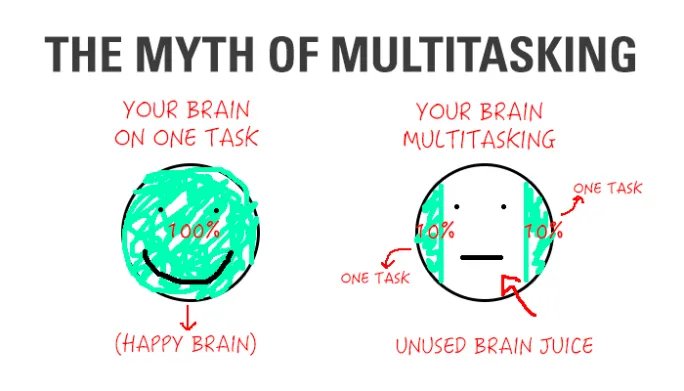

The intricate dance of attention and cognitive processing forms the core of how does multitasking affect your brain? Far from being a superpower, scientific research, particularly in cognitive neuroscience, paints a clear picture: multitasking fundamentally alters your brain's performance in ways that are often detrimental to efficiency, learning, and well-being. This is where the core of multitasking vs single-tasking debate truly lies.
Here's how multitasking impacts your brain:
-
Increased Prefrontal Cortex Activity (and Fatigue):
-
The prefrontal cortex (PFC), located at the front of your brain, is the command center for executive functions: planning, decision-making, problem-solving, and directing attention.
-
When you multitask, your PFC is constantly working overtime, rapidly shifting between tasks, setting new goals for each switch, and trying to filter out irrelevant information. This intense, continuous activity leads to rapid mental fatigue and cognitive overload from multitasking. It's like running a demanding software program non-stop without proper cooling – it overheats.
-
-
Reduced Grey Matter Density (Potential Long-Term Structural Changes):
-
Emerging research suggests that chronic, heavy multitasking might even lead to structural changes in the brain. A study published in PLoS ONE found that heavy media multitaskers had lower grey matter density in the anterior cingulate cortex (ACC) – a region involved in cognitive control, emotional regulation, and decision-making. While causality isn't fully established (does multitasking cause this, or are people with lower density more prone to multitask?), it points to a concerning correlation between multitasking and brain performance.
-
-
Impaired Memory Formation (Hippocampus Underpressure):
-
For information to move from short-term to long-term memory, the hippocampus needs focused attention to encode it properly. When you multitask, your attention is divided, and the hippocampus struggles to consolidate memories effectively. This means you forget more easily, struggle to learn new concepts deeply, and often recall fragmented information.
-
-
Dopamine Addiction and Reward Loop:
-
Every time you switch tasks or receive a new notification (email, text, social media like), your brain gets a small hit of dopamine, a neurotransmitter associated with reward and pleasure. This creates a dopamine addiction loop, making your brain crave constant novelty and external stimulation. This is a significant factor in why our attention span and multitasking are so intertwined, and why it's so hard to resist the urge to switch.
-
-
Reduced Ability to Filter Irrelevant Information:
-
Heavy multitaskers often struggle to ignore irrelevant stimuli. Their brains become less efficient at filtering out distractions because they are constantly scanning for new information. This makes it harder to achieve true focus vs multitasking.
-
-
Increased Cortisol (Stress Hormone) Production:
-
The constant pressure of juggling multiple tasks and the resulting cognitive overload trigger the release of stress hormones like cortisol. Chronic elevation of cortisol can have numerous negative health effects, including impaired immune function, sleep problems, and heightened anxiety (is multitasking linked to anxiety?).
-
-
Weaker Executive Functioning Over Time:
-
Paradoxically, while the PFC works overtime, its overall effectiveness can diminish over time with chronic multitasking. Your ability to plan, prioritize, and make sound decisions without external cues can weaken, making how to single-task effectively even more challenging if not addressed.
-
In essence, multitasking isn't just inefficient; it's a form of self-sabotage for your brain. It exhausts critical cognitive resources, impairs memory and learning, potentially alters brain structure, and creates addictive loops that erode your natural capacity for sustained focus. Embracing single-tasking for mental clarity is not just a productivity hack; it's a brain-healthy habit.
People Also Ask: How does multitasking affect your brain? Multitasking significantly affects your brain by intensely engaging the prefrontal cortex, leading to rapid mental fatigue and cognitive overload from multitasking. Emerging research suggests it might even lead to reduced grey matter density in areas critical for cognitive control, negatively impacting overall multitasking and brain performance. It impairs memory formation because the hippocampus struggles to consolidate information with divided attention. The constant switching and notification responses create a dopamine addiction loop, which contributes to a diminished attention span and multitasking. Furthermore, it reduces the brain's ability to filter irrelevant information, increases cortisol (stress hormone) production, linking multitasking to anxiety, and can ultimately weaken overall executive functioning over time. These profound effects clearly illustrate why multitasking doesn't work efficiently and underscore the importance of strategies like single-tasking for mental clarity.
9. What are the benefits of single-tasking at work?

Given the extensive downsides of multitasking, it's clear that single-tasking isn't just an alternative; it's a superior approach for professional environments. What are the benefits of single-tasking at work? The advantages extend far beyond mere productivity, impacting work quality, mental well-being, and overall career growth.
Here are the key benefits of embracing single-tasking in the workplace:
-
Increased Productivity and Efficiency:
-
By eliminating "switch costs," you complete tasks faster. Your brain isn't wasting time re-orienting itself, allowing for a seamless flow from start to finish. This is the direct opposite of multitasking productivity myths.
-
More focused work leads to more output in less time, making it the real winner in the multitasking vs single-tasking debate for efficiency.
-
-
Higher Quality of Work:
-
When your full attention is dedicated to one task, you notice details, catch errors, and produce more thorough, thoughtful, and high-quality results. This reduces the need for revisions and rework, saving time in the long run.
-
This directly enhances your professional reputation and the impact of your contributions.
-
-
Enhanced Focus and Concentration (Deep Work):
-
Single-tasking naturally enables deep work vs multitasking. You create the mental space necessary to dive deep into complex problems, engage in creative thinking, and perform cognitively demanding tasks without interruption.
-
This strengthens your "focus muscle" over time, making it easier to concentrate even on challenging assignments. This is core to focus vs multitasking.
-
-
Improved Problem-Solving and Creativity:
-
Complex challenges and innovative solutions require sustained, uninterrupted thought. Single-tasking provides the fertile ground for these processes, allowing your brain to connect ideas, explore possibilities, and arrive at more effective solutions.
-
-
Reduced Stress and Mental Fatigue:
-
By reducing cognitive overload from multitasking, single-tasking promotes a calmer, more controlled working environment. Your brain isn't constantly battling multiple inputs, leading to less mental exhaustion and a greater sense of peace at the end of the day. This contributes to single-tasking for mental clarity.
-
-
Better Decision-Making:
-
When your cognitive resources are fully directed towards a decision, you can weigh options more thoroughly, consider consequences, and arrive at more sound, well-reasoned conclusions.
-
-
Increased Job Satisfaction and Sense of Accomplishment:
-
Completing one task thoroughly and seeing tangible progress provides a profound sense of accomplishment. This contrasts with the fragmented feeling of constantly being busy but never truly finishing anything when multitasking. This boosts morale and job satisfaction.
-
-
Stronger Memory and Faster Learning:
-
When you single-task, your brain is better able to encode information into long-term memory. This means you learn new skills faster, retain client information more effectively, and build expertise more efficiently. This positive impact on multitasking and brain performance makes learning more robust.
-
-
Better Time Management and Multitasking Avoidance:
-
By strategically choosing one task and dedicating a specific time to it, you naturally improve your overall time management. It encourages a proactive approach to your schedule rather than a reactive one driven by constant interruptions. This aligns with effective productivity techniques 2025.
-
In essence, single-tasking at work isn't just about efficiency; it's about transforming your entire professional experience. It leads to smarter work, higher quality output, less stress, and a greater sense of purpose and accomplishment, making it an indispensable skill in any demanding role.
People Also Ask: What are the benefits of single-tasking at work? The benefits of single-tasking at work are extensive and crucial for true efficiency, making it the real winner in the multitasking vs single-tasking debate. It leads to increased productivity and efficiency by eliminating "switch costs," directly challenging multitasking productivity myths. You achieve a higher quality of work as your undivided attention reduces errors. It enhances focus and concentration, enabling deep work vs multitasking and fostering focus vs multitasking. This approach also improves problem-solving and creativity, significantly reduces stress and mental fatigue by alleviating cognitive overload from multitasking, and promotes better decision-making. You gain increased job satisfaction from seeing tasks through to completion, enjoy stronger memory and faster learning due to the positive impact on multitasking and brain performance, and develop superior time management and multitasking avoidance strategies. Ultimately, single-tasking for mental clarity is a vital productivity technique 2025 that transforms your professional output and well-being.
10. How can I stop multitasking and stay focused?


Recognizing the detrimental effects of multitasking is the first step; the next, and often most challenging, is learning how can I stop multitasking and stay focused? It's a habit ingrained by modern work culture and digital devices, but with intentional practice and strategic adjustments, you absolutely can train your brain to single-task.
Here's a comprehensive guide to help you transition from the chaos of multitasking to the clarity of single-tasking:
-
Understand Your Triggers:
-
Before you can stop, observe when and why you multitask. Is it an email notification? A buzzing phone? A colleague walking by? A sudden thought about another task?
-
Identifying these triggers is the first step to mitigating them.
-
-
Create a Distraction-Free Environment:
-
Digital Hygiene:
-
Turn Off Notifications: This is paramount. Silence all non-essential notifications on your phone, desktop, and email. Put your phone on "do not disturb" or even in another room.
-
Close Unnecessary Tabs/Apps: Only have open what's directly related to the task at hand. Use browser extensions that block distracting websites during work blocks.
-
-
Physical Environment: Clear your workspace of clutter. Use headphones if your environment is noisy. Inform colleagues if you're entering a "focus mode."
-
-
Implement Time Blocking (Your Single-Tasking Schedule):
-
This is the most powerful tool for how to single-task effectively.
-
Schedule Focus Blocks: Allocate specific, uninterrupted blocks of time in your calendar for your most important, cognitively demanding tasks (deep work vs multitasking).
-
Batch Similar Tasks: Group smaller, similar tasks (like email, admin, calls) into dedicated blocks to reduce context-switching cost. This addresses time management and multitasking by creating order.
-
Treat Blocks as Appointments: View these as non-negotiable meetings with yourself.
-
-
Prioritize One Task at a Time (The "Most Important Task"):
-
At the start of your day, identify the ONE most important task you absolutely must complete. Commit to working on that task first during your peak focus time.
-
This simplifies your decision-making and ensures critical work gets done. This is a core single-tasking benefit.
-
-
Practice the "Pomodoro Technique":
-
This involves working for 25 minutes on a single task, followed by a 5-minute break. After four "Pomodoros," take a longer 15-30 minute break.
-
This trains your attention span and multitasking resistance by providing structured, short bursts of focus and rewarding them with breaks, making it easier to stick to.
-
-
Use a "Distraction Pad" (or "Thought Capture"):
-
When an unrelated thought, idea, or reminder for another task pops into your head during a single-tasking block, resist the urge to act on it immediately. Instead, quickly jot it down on a physical notepad or a dedicated digital note app, and then immediately return to your primary task.
-
This acknowledges the thought without derailing your focus.
-
-
Take Intentional Breaks:
-
Don't just collapse into checking your phone. Use breaks to stand up, stretch, walk, get water, or simply look away from your screen. These intentional breaks refresh your brain and make it easier to re-engage with your single task.
-
-
Practice Mindfulness and Self-Awareness:
-
Pay attention to when you feel the urge to switch tasks. Ask yourself: "Am I truly done with this? Or am I avoiding something?"
-
Engage in short mindfulness exercises to improve your ability to stay present and observe distracting thoughts without acting on them. This strengthens the multitasking vs mindfulness connection.
-
-
Be Patient and Forgiving:
-
You've likely been multitasking for years, possibly decades. It's a deeply ingrained habit. You will slip up. Don't beat yourself up. Acknowledge the slip, gently redirect your attention, and recommit to single-tasking for the next block. Consistency over perfection is the goal.
-
By systematically applying these strategies, you can progressively weaken the habit of multitasking and build the powerful, highly effective skill of single-tasking, leading to improved productivity, reduced stress (is multitasking linked to anxiety?), and greater mental clarity.
People Also Ask: How can I stop multitasking and stay focused? To stop multitasking and stay focused, you must first understand your triggers for distraction. Then, create a distraction-free environment by rigorously turning off notifications and closing unnecessary tabs, which is central to how to single-task effectively. Crucially, implement time blocking to schedule dedicated focus blocks for deep work vs multitasking, treating these as non-negotiable appointments. Prioritize one task at a time, often your Most Important Task, to simplify decision-making. Practice techniques like the Pomodoro Technique to train your attention span and multitasking resistance with structured bursts of focus. Use a "distraction pad" to capture stray thoughts without derailing your current task, and take intentional breaks to refresh. Cultivate mindfulness and self-awareness to recognize the urge to switch, strengthening the multitasking vs mindfulness connection. Finally, be patient and forgiving with yourself, as building this habit takes time. These strategies are vital productivity techniques 2025 to transition from the pitfalls of multitasking and brain performance to the clear advantages of single-tasking for mental clarity, effectively improving your time management and multitasking capabilities.
Multitasking vs. Single-Tasking: The Clarity You Deserve
We've peeled back the layers of a deeply ingrained modern habit, shattering the multitasking productivity myths that have long dictated our busy lives. From the frantic juggling act that felt like peak efficiency, we've uncovered a quieter, more powerful truth: that multitasking vs single-tasking isn't a fair fight. For anything requiring genuine thought, quality, or creativity, single-tasking emerges as the undisputed champion.
The science is stark: our brains aren't built for simultaneous complex processing. What we call multitasking is mere task-switching, an exhausting, error-prone endeavor that leads to cognitive overload from multitasking, diminished attention span and multitasking resilience, and a concerning link between multitasking and brain performance that can even affect brain structure and contribute to anxiety. It's fundamentally why multitasking doesn't work for true productivity.
But here's the beautiful part: the antidote is readily available and remarkably effective. Embracing single-tasking benefits means cultivating focus vs multitasking, engaging in deep work vs multitasking, and actively learning how to single-task effectively. It's about giving your undivided attention to one thing at a time, allowing for profound single-tasking for mental clarity, higher quality output, and a surprising reduction in stress.
As we move further into productivity techniques 2025, the emphasis is less on doing more, and more on doing better. The choice isn't just about efficiency; it's about safeguarding your mental well-being, improving your learning capabilities, and finding true satisfaction in your work. So, silence those notifications, close those unnecessary tabs, and commit to the power of one. Your brain, your work, and your peace of mind will thank you for it.
Maybe you are interested:
Side Hustle vs Main Job: Where Should You Invest Your Energy First?

To-Do List vs Time Blocking: Which Productivity Method Actually Works?
More Like This

How to Improve Your Life: A Complete Guide to Personal Growth
by Emily Cooper
Why is sleep important? What do you need to know about sleep?
by Emily Cooper